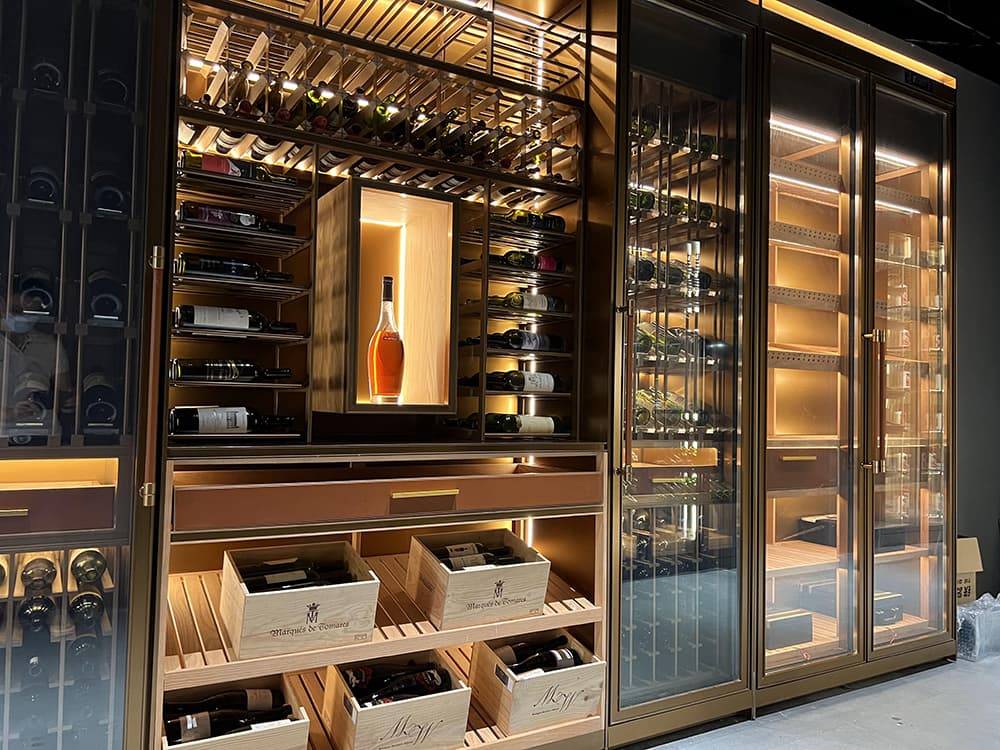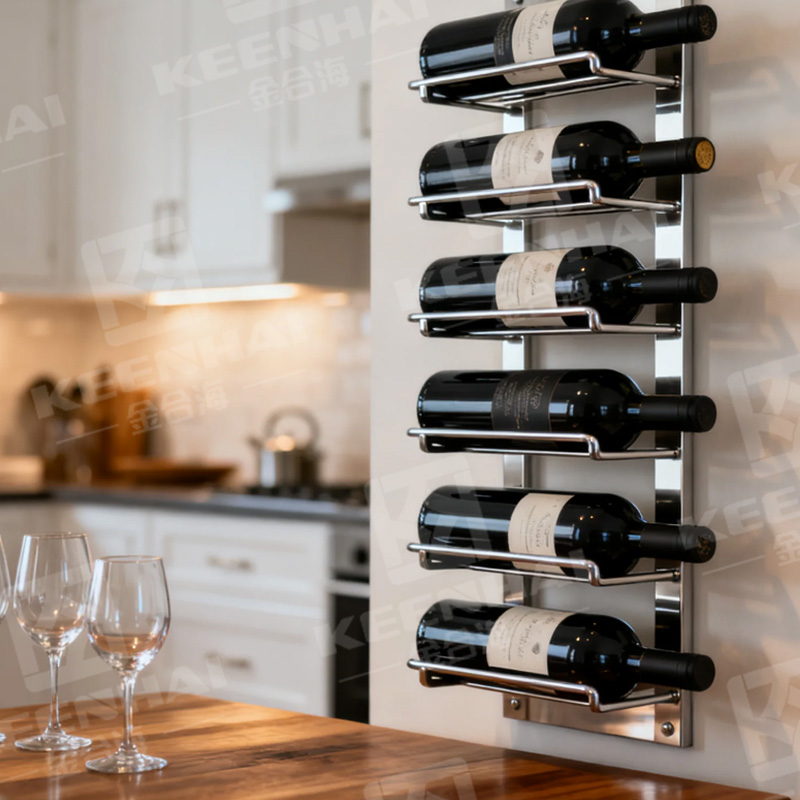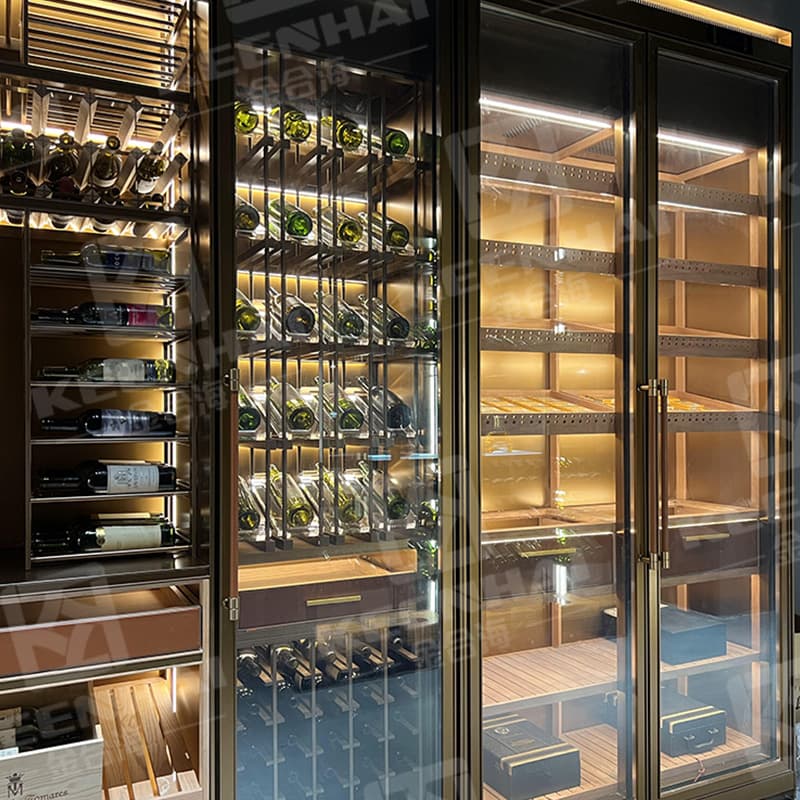
Getting a custom stainless steel wine cellar starts with assessing your storage requirements and communicating them clearly to the manufacturer. Provide detailed dimensions, wine types, and capacity needs, then work with the manufacturer through sampling and design approvals. This ensures your cellar meets functional expectations while reflecting your preferred aesthetic, giving you a personalized solution without compromise.
1. Manufacturer Capabilities and Production Scope
In custom stainless steel wine cellar projects, manufacturer capability defines the real ceiling of what can be delivered. This has nothing to do with marketing language or product variety. It comes down to whether the factory controls critical fabrication steps, maintains engineering-level tolerances, and can repeat results across projects without quality drift. A reliable stainless steel wine cellar manufacturer operates more like an industrial partner than a furniture supplier, especially in commercial or high-value residential environments.
From real-world projects—such as hotel wine display rooms or private cellar installations above 500 bottles—the difference becomes obvious early. Manufacturers with in-house fabrication respond faster to design changes, lock dimensions earlier, and reduce coordination errors. Those relying heavily on outsourced workshops often struggle once drawings turn into metal. Production scope is not about how many designs a factory advertises, but how much of the process it truly owns.
1.1 In-House Fabrication vs Outsourced Manufacturing
Manufacturers with in-house cutting, forming, welding, and surface finishing maintain tighter control over both timelines and tolerances. This matters because stainless steel wine cellar systems involve intersecting frames, load-bearing racks, and door alignments that compound small errors. When fabrication happens internally, teams adjust jigs, revise bend angles, and test assemblies before shipment instead of discovering issues on site.
Outsourced manufacturing introduces fragmentation. Each handoff increases risk: drawings get interpreted differently, finish consistency varies, and corrective work shifts to installation crews. In large-scale stainless steel wine cellar projects, this often translates into longer lead times and higher coordination costs, even if the initial quote appears lower.
| Aspect | In-House Fabrication | Outsourced Manufacturing |
|---|---|---|
| Dimensional control | ±1–2 mm achievable | Often ±3–5 mm |
| Design revision speed | Same-day to 48 hours | Several days or weeks |
| Finish consistency | High, batch-controlled | Varies by subcontractor |
| Installation risk | Predictable | Higher adjustment on site |
1.2 Customization Limits, Tolerances, and Engineering Capacity
Customization does not mean unlimited freedom. Every capable manufacturer defines clear boundaries around panel sizes, rack spans, glass interfaces, and allowable deflection. The strongest factories communicate these limits early, using shop drawings and structural calculations instead of vague assurances.
For example, when designing stainless steel wine storage systems with integrated racks and doors, engineering capacity determines whether frames remain square after loading hundreds of bottles. Manufacturers with real engineering support calculate load distribution, thermal expansion, and anchoring points before fabrication begins. This is especially critical in full-room cellar builds where racks, cabinets, and doors function as one structural system rather than isolated components.
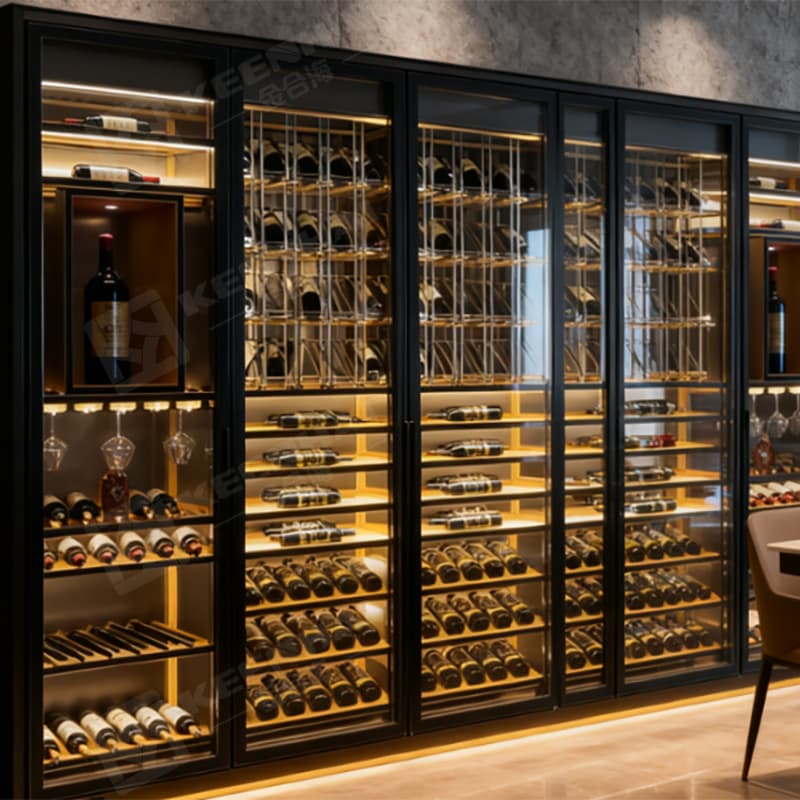
When these capabilities exist, manufacturers can confidently support complex configurations—such as combining fixed racks with enclosed stainless steel wine cabinets for mixed-use storage—without pushing risk downstream. That is the difference between a supplier who sells components and a manufacturer who delivers systems.
2. Materials, Craftsmanship, and Quality Control
Material choice and workmanship define whether a stainless steel wine cellar remains structurally stable and visually consistent after years of use. Unlike decorative metalwork, wine cellar systems face long-term static loads, frequent door operation, and constant temperature and humidity exposure. A true stainless steel wine cellar system relies on material discipline and repeatable fabrication standards, not surface-level aesthetics.
Manufacturers with strong quality control start by standardizing material inputs, then lock fabrication methods before scaling production. This approach reduces variation between batches and ensures that large installations—such as hotel wine rooms or commercial display cellars—maintain the same performance as small private builds. When material and process control align, failure points disappear before installation ever begins.
2.1 Stainless Steel Grades, Thickness, and Structural Standards
Most high-quality wine cellar systems rely on 304 or 316 stainless steel, selected based on environment and corrosion risk. Grade alone, however, does not guarantee strength. Thickness and section design matter just as much. For load-bearing racks and vertical frames, manufacturers typically work within 1.2–2.0 mm material thickness, balancing rigidity with fabrication precision.
Structural standards come into play when racks support hundreds of bottles over multiple vertical spans. Reputable manufacturers calculate allowable deflection and set internal limits rather than relying on visual judgment. In practical terms, this means:
-
Defining maximum unsupported rack width
-
Controlling frame depth to resist torsion
-
Standardizing anchor points for wall or floor fixation
When these rules stay consistent, full-room stainless steel wine cellar installations remain square, doors align cleanly, and racks do not sag over time—even in high-capacity layouts.
2.2 Welding, Finishing Methods, and Surface Consistency
Welding quality determines both structural integrity and final appearance. Precision TIG welding dominates high-end cellar fabrication because it allows clean joints with minimal heat distortion. Good manufacturers control weld sequencing, which prevents frame warping and keeps tolerances predictable across large assemblies.
Finishing follows function. Brushed, satin, or bead-blasted surfaces require controlled grain direction and uniform pressure. Inconsistent finishing creates visible tone shifts once lighting reflects off the metal—an issue that becomes obvious in glass-enclosed wine rooms. To prevent this, manufacturers typically:
-
Assign fixed finishing parameters per project
-
Process visible components in matched batches
-
Inspect surface consistency under installation lighting conditions
This level of control separates industrial-grade craftsmanship from decorative metalwork. When welding and finishing standards stay disciplined, the final system reads as a cohesive architectural element rather than a collection of assembled parts.

3. Design Support and Custom Engineering Services
Design support determines whether a custom project moves smoothly from concept to installation or stalls in revisions and site conflicts. For complex stainless steel wine cellar projects, engineering services do more than visualize aesthetics—they translate architectural intent into buildable, verifiable systems. Manufacturers with real engineering depth treat design as a control layer that protects fabrication accuracy, installation efficiency, and long-term performance.
Strong design support reduces on-site improvisation. When drawings, calculations, and coordination happen early, installers follow a defined path instead of solving structural or clearance issues in the field. This discipline matters most in commercial environments, where delays affect multiple trades and operating schedules.
3.1 Shop Drawings, 3D Modeling, and Technical Validation
Professional manufacturers begin with shop-level drawings, not conceptual sketches. These documents lock dimensions, tolerances, anchor locations, and interface points with walls, floors, and glazing systems. 3D models then validate spatial fit, bottle access angles, and door swing clearances before fabrication starts.
A reliable workflow typically includes:
-
Translating architectural layouts into fabrication-ready drawings
-
Building 3D models to confirm rack alignment and service access
-
Running clash checks against lighting, HVAC diffusers, and glass panels
This process prevents late-stage changes that drive cost overruns. When shop drawings control production, fabrication errors drop sharply, and installation teams receive assemblies that fit as designed. For large wine rooms in hotels or restaurants, this step often saves weeks compared to reactive, on-site adjustments.
3.2 Load Calculations, Climate Integration, and Compliance Requirements
Engineering support extends beyond geometry. Load calculations confirm that racks support full bottle capacity without deflection, especially in tall or cantilevered layouts. Engineers define load paths, anchor forces, and allowable spans based on real material properties, not assumptions.
Climate integration follows the same logic. Designers coordinate rack spacing, air return paths, and enclosure details so cooling systems perform efficiently without condensation or uneven temperatures. In practice, this means:
-
Aligning rack layouts with airflow patterns
-
Allowing service clearance for cooling units
-
Confirming that materials tolerate long-term humidity exposure
Compliance checks—such as seismic anchoring or local building requirements—also happen at this stage. When engineering validation finishes before fabrication, projects install faster, pass inspections smoothly, and perform as intended from day one.
4. Pricing Structure and Cost Transparency
Understanding how manufacturers arrive at a price is critical for planning a custom project. Pricing transparency allows you to compare offers effectively and avoid hidden costs that can accumulate during fabrication and installation. For a commercial stainless steel wine cellar, cost is influenced by material selection, engineering complexity, and finishing requirements. Projects with precise specifications reduce the likelihood of expensive change orders and allow both client and manufacturer to plan budgets with confidence.
Clear pricing also helps anticipate lifecycle expenses. When cost calculations are broken down by component—racks, cabinetry, doors, climate systems, and installation labor—you can assess where value is gained and where over-specification inflates prices unnecessarily. Transparency here is a strategic advantage for commercial operators managing multiple trades and tight timelines.
4.1 How Manufacturers Build Pricing for Custom Wine Cellars
Manufacturers calculate costs using a layered approach that combines material, labor, and overhead factors:
-
Material selection – Grade of stainless steel, sheet thickness, surface finish, and supplementary components such as stainless steel wine racks.
-
Engineering and design complexity – Custom layouts, load calculations, and climate integration that require additional shop drawings or modeling.
-
Fabrication and assembly time – Labor hours for cutting, welding, finishing, and quality control, often adjusted for modular versus site-built assemblies.
-
Installation logistics – Transport, site prep, and handling of delicate materials.
A transparent manufacturer provides a line-item breakdown, allowing clients to see exactly what contributes to the total price instead of offering a flat, opaque figure.
4.2 Tooling Costs, Design Fees, and Change Order Policies
Specialized tooling and custom jigs can add 5–15% to the initial quote, depending on project scale. Design fees cover advanced modeling, 3D simulations, and validation reports. Change orders—when specifications shift mid-project—can further affect the final cost. Best-in-class manufacturers clearly define these policies upfront, showing the cost impact of optional upgrades or last-minute adjustments.
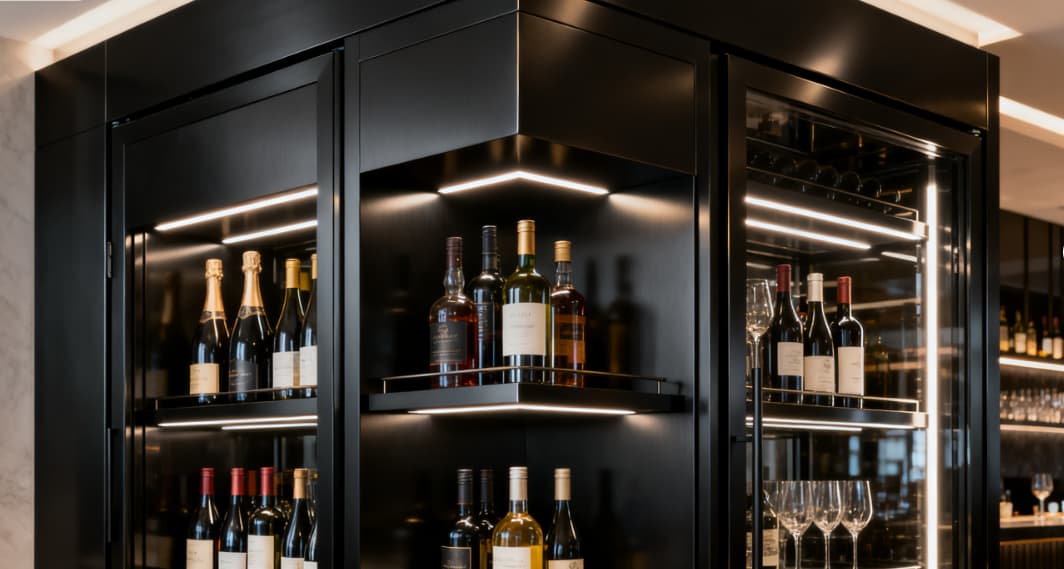
For example, selecting a stainless steel wine rack cabinet with custom finishes or integrating a room-temperature wine cabinet will have predictable cost additions if documented in the initial quote. Transparent terms prevent surprises, ensuring the client understands exactly what each dollar covers.
5. Lead Time, Logistics, and Project Coordination
Efficient coordination between manufacturing and on-site installation is critical for commercial stainless steel wine cellars. Lead times vary depending on material availability, customization complexity, and production capacity, so early planning reduces delays and prevents rushed adjustments that inflate costs. A structured timeline ensures that sampling, approval, packaging, shipping, and installation proceed in sync, which is especially crucial for high-value, climate-sensitive wine storage systems.
Clear logistics planning prevents damage during transport. By breaking down the workflow into discrete stages, manufacturers and clients can anticipate bottlenecks, optimize resource allocation, and schedule labor efficiently. Proactive communication with vendors, shipping carriers, and site teams guarantees smooth transitions from factory floor to installation site, minimizing risk and maintaining quality standards.
5.1 Production Timeline, Sampling, and Approval Stages
A robust production schedule typically involves 3–5 key stages:
-
Initial fabrication and prototype or sample creation – Verify material quality, finish consistency, and modular fit.
-
Internal quality checks – Confirm structural integrity, weld uniformity, and surface treatment before client review.
-
Client review and approval – Approve final finishes, layout, and functional elements such as stainless steel wine racks or cabinet arrangements.
-
Final adjustments – Implement minor corrections based on client feedback.
-
Production completion and readiness for shipment – Ensure all components meet specifications and are securely packaged.
Each stage adds predictability to lead times, allowing clients to align other construction or interior work around cellar installation.
5.2 Packaging, Shipping Methods, and On-Site Delivery Planning
Proper packaging protects stainless steel surfaces and sensitive components during transit. Step 1: Wrap individual panels with protective film and cushioning. Step 2: Assemble modular units onto reinforced crates for stability. Step 3: Label all parts clearly for seamless on-site assembly.
Shipping options depend on distance, handling requirements, and climate sensitivity. For international or cross-city transport, manufacturers often coordinate freight logistics with specialized carriers experienced in handling premium wine storage systems. On-site delivery planning includes measuring elevator capacity, access routes, and staging areas, so teams can unload and assemble efficiently. These steps ensure that a stainless steel wine rack cabinet or full cellar arrives intact and installation proceeds without delay, preserving both aesthetics and functionality.