Pêşkêş
When hotel owners, mall developers, and interior architects evaluate ceiling materials for large-scale commercial projects, stainless steel consistently emerges as a premium choice. Its blend of durability, fire resistance, and modern aesthetics makes it especially appealing for hospitality lobbies, luxury retail corridors, and high-traffic atriums. But the question that inevitably comes first is: how much does a stainless steel ceiling actually cost per square meter?
In 2026, the global metal ceilings market is valued at approximately USD 4.78 billion and is projected to reach USD 6.72 billion by 2035. Stainless steel occupies a significant share of this market, driven by demand from the hospitality and commercial sectors. This guide breaks down every cost component — from raw material grades and surface finishes to installation methods and regional pricing — so you can plan your project budget with confidence.
1. Why Stainless Steel Ceilings for Hotels and Malls?
Before diving into numbers, it helps to understand why stainless steel is worth the investment in commercial spaces.
Durability and lifespan. Stainless steel ceilings have a service life exceeding 50 years, dramatically outlasting gypsum board (10–15 years) or mineral fiber panels (10–15 years). For a hotel or mall that undergoes renovations every 15–20 years, this means the ceiling may never need replacement.
Fire safety. Stainless steel achieves an A-grade fire rating, the highest classification available. This is a non-negotiable requirement for hotel lobbies, mall atriums, and evacuation corridors in most building codes worldwide.
Moisture and corrosion resistance. Unlike gypsum or mineral fiber, stainless steel does not warp, sag, or degrade in humid environments — critical for hotel bathrooms, indoor pools, food courts, and coastal properties.
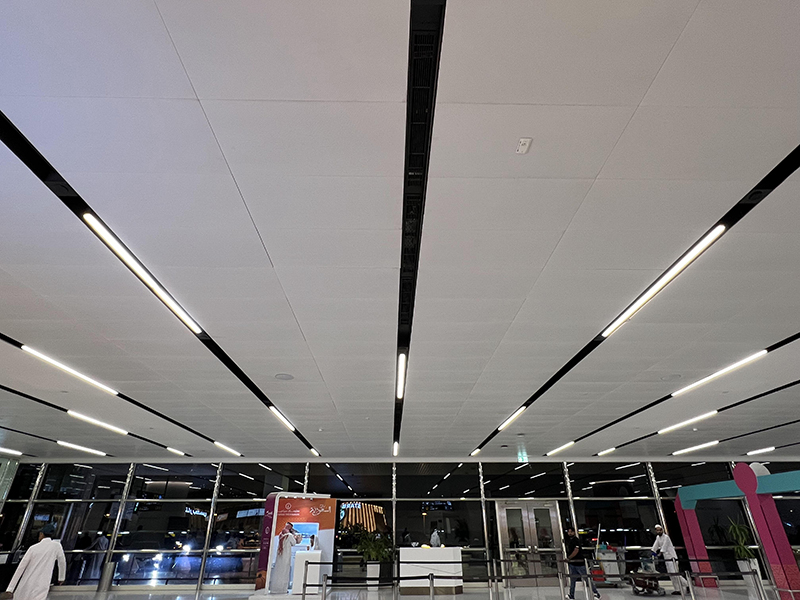
Aesthetic versatility. Brushed and polished finishes deliver distinctly different visual effects that align with brand positioning. A luxury hotel lobby might opt for mirror-polished panels to amplify light and create a sense of grandeur, while a boutique hotel corridor might prefer the understated elegance of a brushed satin finish.
Low maintenance. Stainless steel requires only occasional wiping with a damp cloth. There is no repainting, no resealing, and no risk of mold growth — a significant operational cost saving over decades.
2. Understanding Stainless Steel Ceiling Grades: 304 vs. 316
The two grades most commonly used in commercial ceiling applications are AISI 304 û AISI 316. The choice between them has a direct impact on cost.
AISI 304 — The Standard Choice
Grade 304 is the workhorse of the stainless steel family. It offers excellent corrosion resistance for typical indoor environments and is suitable for the vast majority of hotel and mall installations. In 2026, 304-grade stainless steel ceiling panels are priced between USD 40 and USD 55 per square meter for standard thicknesses (0.8–1.2 mm).
AISI 316 — The Premium Option
Grade 316 contains molybdenum, which dramatically improves resistance to chloride-induced pitting corrosion. This makes it the preferred grade for coastal hotels, properties near the ocean, or indoor environments with high chemical exposure (such as swimming pool areas or food processing zones).
The price premium is significant: 316 panels cost 40–60% more than equivalent 304 panels, placing them in the range of USD 55 to USD 80 per square meter.
Grade 430 — The Budget Alternative
For cost-sensitive projects in dry, interior-only applications, grade 430 ferritic stainless steel is sometimes specified. It costs roughly USD 20–35 per square meter but lacks the corrosion resistance of 304 or 316. It should never be used in humid or coastal environments, as surface rust can appear within 2–3 years.
3. Stainless Steel Ceiling Surface Finish: Brushed vs. Polished — Cost Comparison
The surface finish is not just an aesthetic decision — it has a measurable impact on production cost and, therefore, the final price per square meter.
Brushed (Satin) Finish
A brushed finish is achieved by running the stainless steel sheet through abrasive belts or pads, creating a uniform directional grain pattern. This process is relatively straightforward and produces less material waste.
- Cost premium over raw material: +10–20%
- Typical price range (304 grade): USD 45–65 per square meter
- Visual effect: Subtle, non-reflective, contemporary
- Best applications: Hotel corridors, elevator lobbies, retail store ceilings, restaurant dining areas
- Practical advantage: Hides fingerprints, minor scratches, and dust accumulation better than polished finishes
Polished (Mirror) Finish
A polished finish requires multiple grinding and buffing stages to achieve a reflective, mirror-like surface. The process is more labor-intensive and generates higher material waste, both of which push the price upward.
- Cost premium over raw material: +25–45%
- Typical price range (304 grade): USD 55–80 per square meter
- Visual effect: Highly reflective, luxurious, light-amplifying
- Best applications: Hotel lobbies, grand staircases, mall atriums, VIP lounges, luxury retail flagships
- Practical consideration: Shows fingerprints and dust more readily; may require anti-fingerprint coating (+USD 3–5/sqm)
Summary Table: Finish Cost Comparison
4. Stainless Steel Ceiling Panel Construction: Solid vs. Honeycomb Core
Stainless steel ceiling panels come in two primary construction types, each with different cost and performance implications.
Solid Stainless Steel Panels
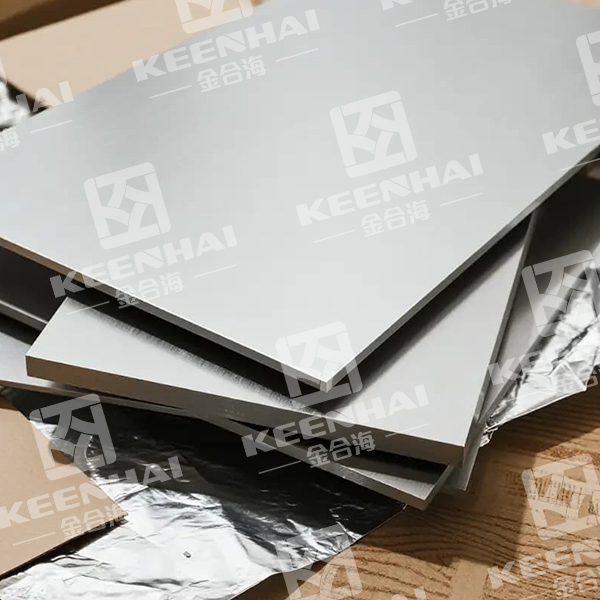
These are single-layer sheets, typically 0.5–2.0 mm thick, backed by a light steel or aluminum frame. They are the more affordable option and work well for standard flat or mildly curved ceiling designs.
- Price range: USD 25–60 per square meter (material only)
- Pîvan: Heavier, requiring a more robust suspension system
- Best for: Smaller areas, feature walls that extend to the ceiling, simple flat layouts
Stainless Steel Honeycomb Panels
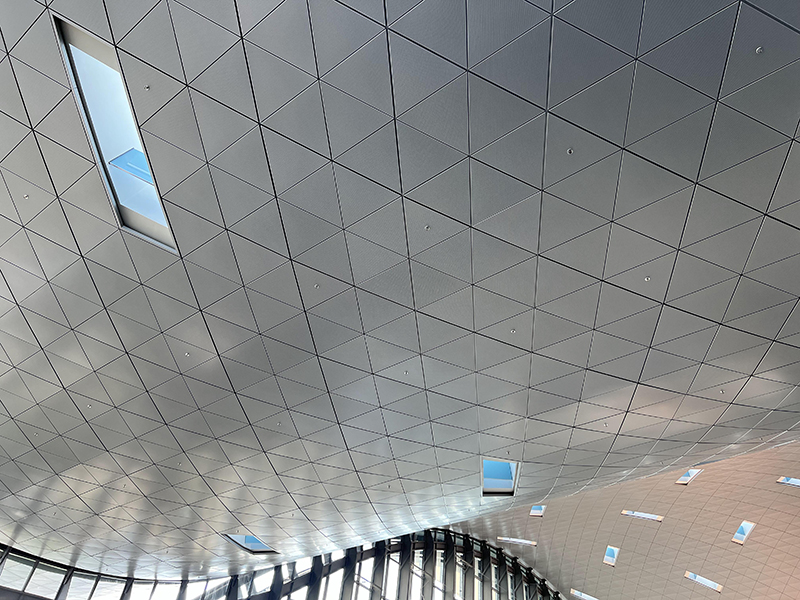
Honeycomb panels feature a thin stainless steel face sheet (0.5–1.5 mm) bonded to an aluminum or stainless steel honeycomb core, with a total thickness of 10–30 mm. This composite construction delivers exceptional flatness and rigidity at a fraction of the weight.
- Price range: USD 50–120 per square meter (material only)
- Pîvan: 50–70% lighter than solid panels of equivalent stiffness
- Best for: Large-span ceilings (hotel atriums, mall corridors), curved or complex geometries, projects requiring integrated lighting or HVAC cutouts
- Long-term value: Superior flatness retention over decades; no sagging or warping
For most hotel and mall projects exceeding 1,000 square meters, honeycomb panels are the recommended choice despite the higher upfront cost, as they reduce structural load on the building and deliver a noticeably superior finish.
5. Stainless Steel Ceiling Installation Costs: Methods and Labor Rates
Installation is the second-largest cost component after materials. The method chosen depends on the panel type, ceiling height, and design complexity.
Common Installation Methods
Clip-in / Snap-in System (USD 8–15/sqm labor)
Panels clip into a pre-installed T-bar grid. This is the fastest method and is standard for tiled or modular ceiling layouts. Labor costs are relatively low because the system requires minimal on-site adjustment.
Panels clip into a pre-installed T-bar grid. This is the fastest method and is standard for tiled or modular ceiling layouts. Labor costs are relatively low because the system requires minimal on-site adjustment.
Screw-fixed / Adhesive System (USD 7–14/sqm labor)
Panels are adhered to a plywood or cement board substrate using structural adhesive, with screws at the perimeter for security. Common for mirror-polished panels where a seamless appearance is desired. Labor is moderate.
Panels are adhered to a plywood or cement board substrate using structural adhesive, with screws at the perimeter for security. Common for mirror-polished panels where a seamless appearance is desired. Labor is moderate.
Concealed Frame System (USD 14–28/sqm labor)
Panels are mounted on a custom-built steel or aluminum frame that is entirely hidden from view. This produces a clean, monolithic ceiling surface and is the preferred method for high-end hotel lobbies and luxury retail spaces. Labor costs are the highest due to the precision required.
Panels are mounted on a custom-built steel or aluminum frame that is entirely hidden from view. This produces a clean, monolithic ceiling surface and is the preferred method for high-end hotel lobbies and luxury retail spaces. Labor costs are the highest due to the precision required.
Regional Labor Rate Variations
Labor rates for ceiling installation vary dramatically by region:
These rates reflect 2026 market conditions and can fluctuate based on local labor availability, project scale, and site conditions (e.g., ceiling height above 4 meters typically adds 15–30% to labor costs).
6. Stainless Steel Ceiling Total Installed Cost Per Square Meter — The Full Picture
To give you a realistic project budget, here is the total installed cost per square meter for stainless steel ceilings in hotel and mall applications, combining material, installation, accessories, and overhead.
Budget Scenario: Brushed 304 Solid Panels, Clip-in System
| Component | Cost (USD/sqm) |
|---|---|
| Material (304 brushed, 0.8 mm) | $45–55 |
| Suspension grid & accessories | $8–12 |
| Installation labor | $8–15 |
| Cutting, edge finishing | $3–8 |
| Total | $64–90 |
Mid-Range Scenario: Brushed 304 Honeycomb Panels, Frame System
| Component | Cost (USD/sqm) |
|---|---|
| Material (304 brushed honeycomb, 15 mm) | $65–90 |
| Frame system & accessories | $12–18 |
| Installation labor | $14–22 |
| Cutting, fabrication | $5–12 |
| Total | $96–142 |
Premium Scenario: Polished 316 Honeycomb Panels, Concealed Frame
| Component | Cost (USD/sqm) |
|---|---|
| Material (316 polished honeycomb, 20 mm) | $90–120 |
| Concealed frame & accessories | $18–25 |
| Installation labor | $20–35 |
| Fabrication & anti-fingerprint coating | $8–15 |
| Total | $136–195 |
7. Cost Factors That Are Easy to Overlook
When budgeting a stainless steel ceiling project, several hidden costs can push the final bill beyond initial estimates.
Ceiling height and access. Projects with ceilings above 4 meters require scaffolding or mechanical lifts, adding USD 3–8 per square meter. Complex atrium spaces with multiple levels compound this cost.
Custom shapes and cutouts. Curved panels, circular cutouts for lighting fixtures, and non-standard panel sizes add 15–40% to fabrication costs. Standard rectangular panels are always the most economical.
Integrated services. When HVAC diffusers, sprinkler heads, speakers, and lighting tracks need to be coordinated with the ceiling panels, the planning and fabrication effort increases significantly. Budget an additional USD 5–15 per square meter for integrated service coordination.
Shipping and logistics. For international projects, shipping stainless steel panels from manufacturing hubs (primarily in East Asia) can add USD 5–15 per square meter, depending on volume, distance, and whether containers or air freight are used.
Surface protection during construction. Polished finishes must be protected with temporary film or board during installation and the remaining construction phase. Budget USD 2–4 per square meter for protective measures.

8. Stainless Steel Ceiling vs. Alternative Ceiling Materials — A Cost Comparison
How does stainless steel stack up against other premium ceiling options for hotels and malls?
While stainless steel has the highest upfront cost, its lifecycle cost per year is among the lowest. A 50-year lifespan with virtually zero maintenance means the annualized cost is often lower than replacing a gypsum ceiling three times over the same period.
9. Practical Budgeting Tev stîl Ceiling Tips for Hotel and Mall Projects
Standardize panel sizes. Using standard 600×600 mm or 600×1200 mm panels minimizes cutting waste and reduces fabrication costs by up to 20%.
Choose the right grade for the zone. Use 316 only where environmental conditions demand it (coastal, pool, or food areas). Use 304 for the remaining 80–90% of the project to control costs.
Mix finishes strategically. Use polished finishes in high-visibility areas (lobbies, entrances, atriums) and brushed finishes in corridors, back-of-house, and secondary spaces. This approach can reduce total finish costs by 15–25% without sacrificing the premium feel.
Order in bulk. For projects exceeding 2,000 square meters, most manufacturers offer volume discounts of 8–15% on material costs. Coordinate procurement across phases to maximize this benefit.
Invest in quality installation. A poorly installed stainless steel ceiling — with visible seams, uneven panels, or misaligned lighting cutouts — undermines the entire design intent. Allocate adequate budget for skilled installers, even if it means choosing a slightly less expensive material grade.
10. Conclusion: Is a Stainless Steel Ceiling Worth the Investment in 2026?
The short answer is yes — particularly for hotels and malls where the ceiling is a dominant visual element that must perform flawlessly for decades. At a total installed cost ranging from approximately USD 64 to USD 195 per square meter depending on specification, stainless steel ceilings represent a premium but justifiable investment.
The key to controlling costs lies in making informed choices at every decision point: selecting the right grade for each zone, choosing between brushed and polished finishes based on visibility and function, and investing in proper installation from the start. When planned thoughtfully, a stainless steel ceiling delivers unmatched longevity, fire safety, and aesthetic impact — making it one of the most cost-effective premium ceiling solutions available in 2026.
This guide reflects market pricing data as of mid-2026. Actual costs may vary based on project location, scale, design complexity, and supplier negotiations. For precise budgeting, always request detailed quotations from qualified ceiling system suppliers.