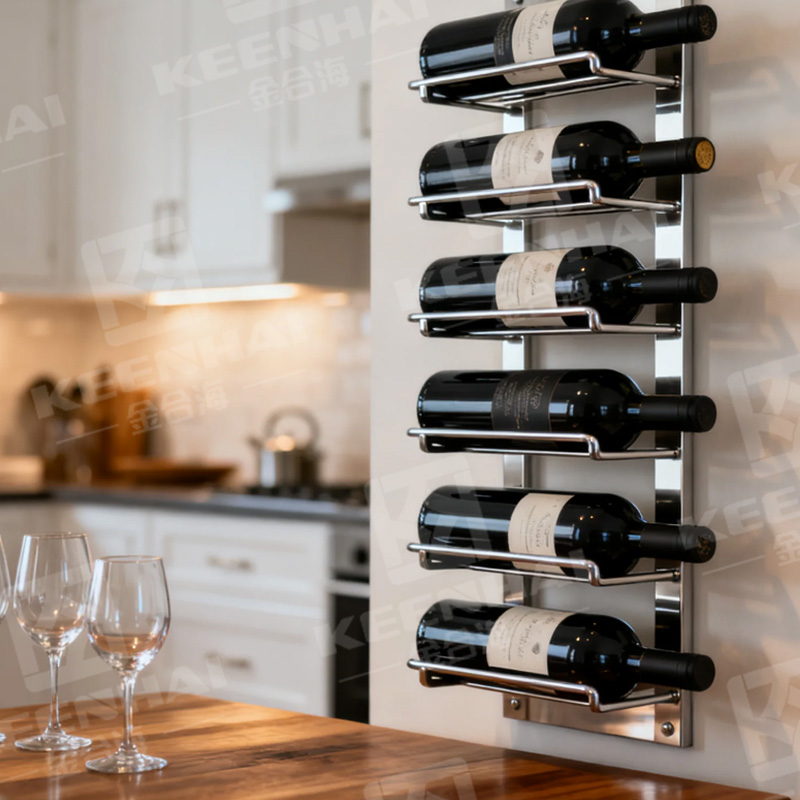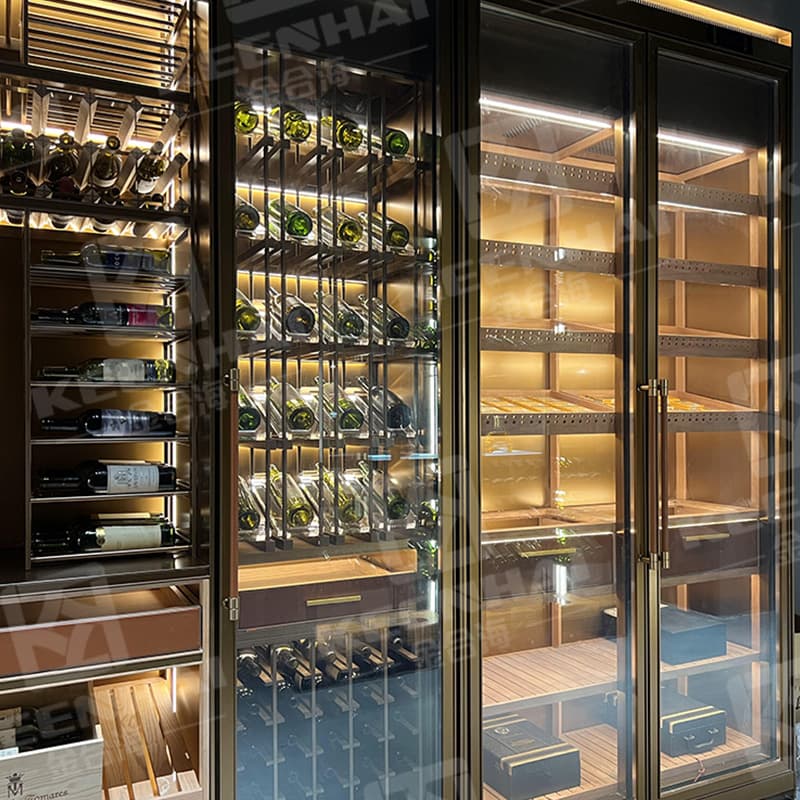
A standard stainless steel wine cellar for a private residence usually costs between $20,000 and $50,000. This range covers basic modular racks, standard 304 stainless steel finishes, and entry-level climate control. Factories adjust pricing based on rack density, insulation thickness, and finish quality. Buyers can often request a custom-built wine cellar system for slightly higher prices to better match storage needs and space layout.
1. Cost Factors Influencing Stainless Steel Wine Cellar Pricing
The pricing of a Вински подрум од нерђајућег челика largely depends on material choices, structural complexity, and the integration of climate control systems. For hotel or luxury residential projects, understanding these cost drivers helps stakeholders make informed decisions without compromising on durability or aesthetics. Key cost factors typically fall into three main categories: materials, rack and storage systems, and environmental control components.
1.1 Material Selection: Stainless Steel Grades and Finishes
Material selection directly impacts both the upfront cost and long-term maintenance of a wine cellar. Premium grades like 304 or 316 stainless steel offer superior corrosion resistance, especially in humid environments, but their price can be 20–35% higher than standard 201-grade steel. Finishes such as brushed, mirror-polished, or powder-coated surfaces add another layer of cost due to additional processing steps.
In practice, large hospitality projects often require custom-built wine cellars where designers specify steel grades for aesthetic and functional requirements. For instance, a five-star hotel in Singapore opted for 316L polished stainless steel racks in its cellar to prevent fingerprints and oxidation, which added roughly 15% to the overall project budget but guaranteed long-term performance.
1.2 Rack Systems, Modular Options, and Load Capacity
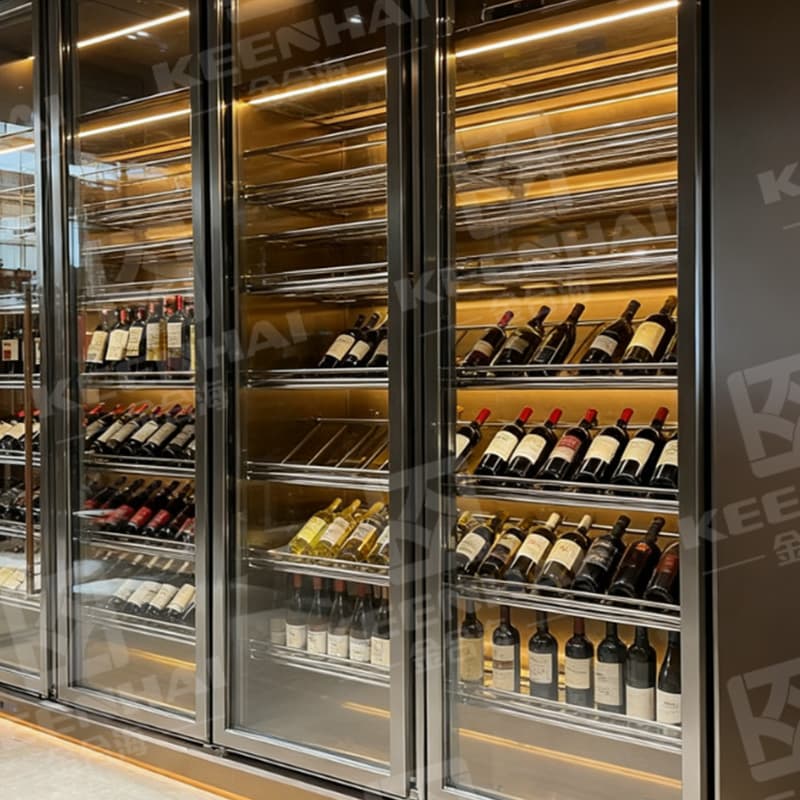
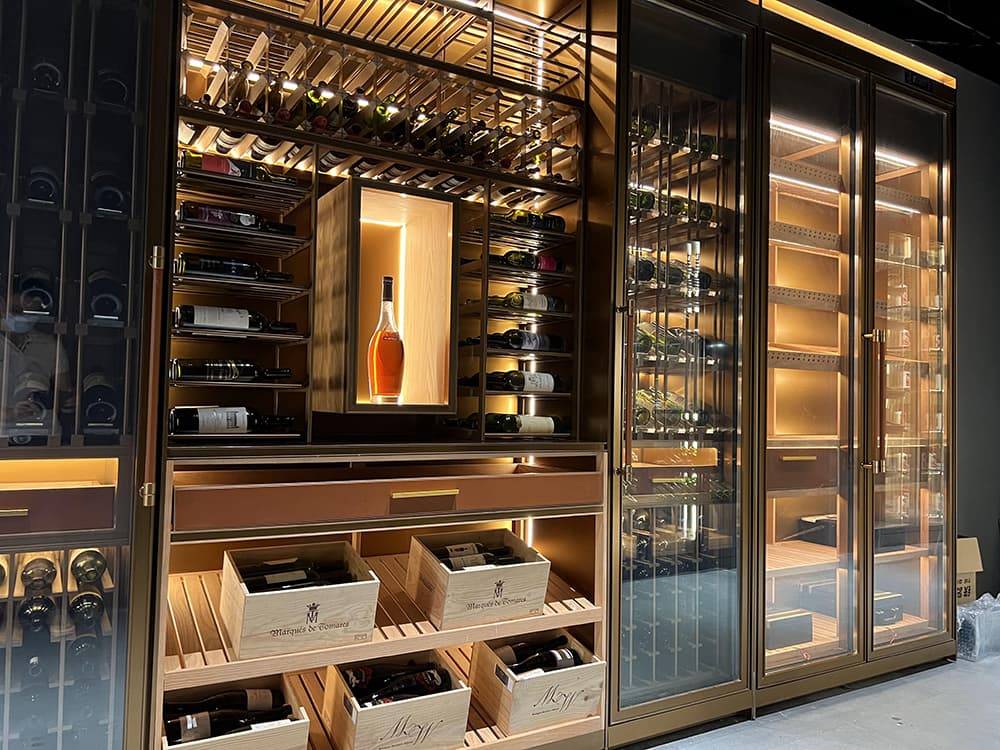
Rack systems are another significant cost driver. Choices range from pre-fabricated modular racks to fully customized, hotel-grade Ормари за вино од нерђајућег челика designed for mixed-use storage. Modular designs simplify installation and reduce labor costs, while custom configurations improve space utilization in irregular room layouts.
Comparison Table: Modular vs Custom Rack Systems
| Феатуре | Modular Racks | Custom Racks / Cabinets |
|---|---|---|
| Flexibility | Limited | High – designed for specific layouts |
| Installation Time | 1–2 days per 50 sq. ft. | 3–5 days per 50 sq. ft., depending on design |
| Load Capacity | Standardized, 12–15 bottles per row | Adjustable, up to 20 bottles per row |
| Maintenance | Easy replacement of sections | Requires specialized service |
| Цост | Lower upfront | 25–40% higher upfront |
For example, a luxury restaurant in Dubai installed custom wine rack cabinets that maximized corner spaces, improving storage capacity by 18% compared to standard modular units. The additional cost was offset by higher storage efficiency and long-term durability.
1.3 Climate Control, Insulation, and Environmental Features
Effective climate control is essential for preserving wine quality, and it significantly affects overall pricing. Components like humidity control units, dual-zone refrigeration, and insulated panels can collectively account for 20–30% of total project costs. Installation steps usually include:
-
Measuring and assessing cellar volume for precise cooling requirements.
-
Installing insulated panels to prevent temperature fluctuations.
-
Setting up dual-zone cooling units for red and white wine storage.
-
Integrating humidity and ventilation systems for consistent air quality.
Hotels and commercial projects often choose environmentally efficient systems that reduce long-term electricity costs. A boutique hotel in Tokyo invested in high-performance insulation and smart climate controls, increasing upfront costs by $12,000, but it reduced energy consumption by 18% annually while ensuring optimal wine preservation.
2. Factory Pricing Models and Quotation Methods
Understanding how a Вински подрум од нерђајућег челика factory sets prices is crucial for hotels and commercial projects to avoid budget overruns. Pricing is rarely fixed and depends on production type, order size, and the inclusion of value-added services. By examining factory pricing models, project managers can anticipate costs and negotiate effectively while ensuring delivery schedules and quality standards.
2.1 Standardized Production vs Custom Orders
Factories typically offer two main pricing models: standardized units и custom orders. Standardized production relies on pre-fabricated racks or cabinets and benefits from economies of scale, reducing per-unit cost by 15–25% compared to fully customized solutions. In contrast, custom orders require:
-
Detailed measurement and design approval for the installation site.
-
Selection of materials, finishes, and optional modular systems.
-
Extended fabrication time, often 2–4 weeks longer than standard units.
For example, a boutique hotel in Shanghai opted for a custom-built wine cellar system tailored to an irregular 60 sq. ft. space, which increased initial costs by 20% but maximized storage efficiency and guest appeal. Custom orders usually outperform mass-produced units in layout adaptability, particularly in hotels with non-standard architectural features.
2.2 Batch Size, Lead Time, and Pricing Variations
Pricing also fluctuates depending on batch size and lead time. Large batch orders allow factories to spread setup costs over multiple units, lowering the price per rack by 10–15%. Conversely, small or one-off orders incur higher unit costs due to labor and setup overhead. Lead times further affect pricing:
-
Standard orders: 1–2 weeks fabrication, minimal surcharge.
-
Rush custom orders: 5–7 days fabrication, 12–20% premium.
Hotels frequently coordinate with factories to schedule deliveries alongside renovation timelines. For instance, a Dubai luxury hotel aligned its hotel-grade stainless wine storage production with a phased interior renovation, ensuring the cellar arrived just before finishing works, avoiding storage costs and potential damage.
2.3 Inclusion of Installation, Delivery, and After-Sales Support
Some factories offer bundled quotations covering installation, delivery, and post-sale support. These packages typically cost 15–25% more than bare units but reduce project management complexity and risk. Standard steps include:
-
Factory inspection and pre-assembly of components.
-
Transportation with shock-resistant packaging.
-
On-site assembly by trained technicians.
-
Testing climate control, load-bearing, and operational adjustments.
-
Provision of maintenance instructions and warranty coverage.
Projects that include these services, especially commercial wine cellar solutions, often experience smoother installations and fewer operational hiccups, justifying the additional cost.
3. Regional and Supplier-Specific Cost Differences
When planning a custom-built wine cellar system for commercial or hotel projects, understanding regional and supplier-specific cost variations is critical. Prices can vary dramatically based on manufacturing location, scale, and reputation. Recognizing these differences allows project managers to make informed procurement decisions and anticipate total project budgets.
3.1 Local vs International Manufacturers
Local manufacturers often provide faster lead times and lower shipping costs, but international producers may offer superior material selection and advanced fabrication techniques. For example, ordering from a European supplier might increase unit cost by 10–20%, but you gain access to premium stainless steel grades and precise modular systems. Hotels in Asia sometimes prefer hotel-grade stainless wine storage from domestic factories for easier coordination with renovation timelines, while luxury resorts in the Middle East often invest in international custom solutions to achieve unique design aesthetics.
3.2 Differences Between Large-Scale Producers and Custom Fabricators
Large-scale producers leverage bulk manufacturing to reduce per-unit cost, but custom fabricators provide superior adaptability for irregular spaces or mixed-use wine storage areas. Key differences include:
| Феатуре | Large-Scale Producer | Custom Fabricator |
|---|---|---|
| Lead Time | 1–2 weeks | 3–6 weeks |
| Layout Flexibility | Limited | High, tailored to site |
| Material Options | Standard | Wide selection including luxury finishes |
| Post-Sale Support | Basic | Extensive, often includes on-site guidance |
For instance, a boutique hotel in Bangkok required a modular stainless steel wine rack system to fit a sloped cellar, which only a commercial wine cellar solution from a custom fabricator could accommodate efficiently.
3.3 Supplier Reputation and Project Experience
Supplier reputation significantly impacts pricing and project risk. Experienced factories with a proven track record for hotel or restaurant projects often charge 15–25% more, but their teams minimize installation errors, optimize layout, and ensure climate control performance. Typical evaluation steps include:
-
Reviewing completed project portfolios and references.
-
Confirming experience with similar-sized wine storage systems.
-
Assessing after-sales service quality and warranty coverage.
Hotels working with reputable suppliers report fewer on-site adjustments and smoother final walkthroughs, justifying the premium cost. Hotel-grade stainless wine storage projects consistently benefit from seasoned suppliers who understand complex logistics, modular compatibility, and environmental controls.

4. Cost Comparison by Wine Cellar Size and Capacity
Understanding the cost variations across Вински подрум од нерђајућег челика sizes is essential for planning both budget and design. Costs scale with capacity because larger setups require more stainless material, advanced rack systems, and sophisticated climate control. Here’s a clear comparison of small, medium, and large-scale wine cellars:
| Wine Cellar Size | Bottle Capacity | Typical Price Range | Material & Rack Type | Climate Control Features | Installation Time |
|---|---|---|---|---|---|
| Small | <500 | $8,000–$20,000 | Modular stainless racks | Basic cooling, single-zone insulation | 3–5 days |
| Средње | 500–2,000 | $20,000–$65,000 | Reinforced modular racks | Zoned cooling, humidity control | 5–10 days |
| Large | >2,000 | $70,000–$200,000+ | Industrial-grade racks | Multi-zone cooling, advanced monitoring | 2–4 weeks |
4.1 Small-Scale Wine Cellars (Under 500 Bottles)
Small-scale wine storage, typically under 500 bottles, often relies on modular stainless steel racks and compact climate control systems. Costs generally range from $8,000 to $20,000, depending on material grade, modular configuration, and finish. For boutique restaurants or luxury hotel suites, a hotel-grade stainless wine storage system can optimize limited space while offering full temperature and humidity management. Installation usually involves:
-
Measuring available cellar space accurately.
-
Selecting modular racks and adjustable shelving.
-
Installing a compact cooling unit with insulated panels.
-
Testing temperature consistency across all bottle levels.
Small projects benefit from flexibility, but careful planning ensures no bottleneck in circulation or access.
4.2 Medium-Scale Wine Cellars (500–2,000 Bottles)
Medium-scale systems require custom-built wine cellar systems with expanded rack layouts, higher load-bearing capacity, and more robust climate control. Prices typically fall between $20,000 and $65,000, influenced by stainless steel grades, modular complexity, and integration with interior design. Hotels in urban centers often prefer mid-size setups to combine storage with tasting areas. Key steps include:
-
Designing L-shaped or U-shaped rack configurations for optimal flow.
-
Selecting reinforced modular racks to handle heavier bottle loads.
-
Integrating climate zoning for different varietals.
-
Coordinating with interior designers to maintain aesthetic continuity.
These systems strike a balance between scalability and cost efficiency, making them ideal for restaurants or hotel wine rooms.
4.3 Large-Scale Wine Cellars (Over 2,000 Bottles)
Large-scale wine cellars, exceeding 2,000 bottles, demand industrial-grade custom wine storage solutions with full climate control, advanced monitoring systems, and premium finishes. Investment can range from $70,000 to over $200,000, depending on rack density, refrigeration zones, and automation features. For resorts or luxury hospitality projects, a commercial wine cellar solution ensures long-term durability and easy inventory management. Implementation usually involves:
-
Conducting a full structural analysis for load-bearing requirements.
-
Installing multi-zone refrigeration and humidity control.
-
Configuring high-density racks with mixed-use areas for tasting and display.
-
Running comprehensive testing for temperature uniformity and system redundancy.
Large cellars provide unmatched storage capacity but require precise planning to optimize both cost and operational efficiency.

5. Budget Planning and Value Considerations
When planning a Вински подрум од нерђајућег челика, cost is more than just the upfront price. Effective budget planning requires balancing material quality, installation complexity, and long-term operational expenses. Commercial clients and high-end residential owners often underestimate the value of durable stainless steel, modular racks, and precision climate systems, which can significantly reduce maintenance and replacement costs over time.
5.1 Balancing Material Quality with Cost Efficiency
Choosing between 304 and 316 stainless steel, brushed or mirror finishes, and different rack types directly impacts both price and longevity. Smaller or standard modular wine racks can lower initial costs, but investing in reinforced structures ensures decades of stability. Consider these steps to balance cost with quality:
-
Determine storage volume and load requirements.
-
Select stainless grade and finish based on environmental exposure.
-
Evaluate modular vs custom rack systems for cost-efficiency.
By optimizing materials and configurations, you maintain premium storage performance without overspending.
5.2 Long-Term Maintenance and Operational Costs
Operational costs often exceed the initial investment if cooling systems, insulation, and humidity control are inefficient. To minimize expenses:
-
Implement energy-efficient climate systems with programmable zones.
-
Choose corrosion-resistant racks and surfaces to reduce cleaning and replacement frequency.
-
Schedule regular inspections of mechanical components and seals.
Medium and large-scale installations, especially those with hotel-grade stainless wine storage, benefit most from proactive maintenance strategies, reducing unexpected downtime and costly repairs.
5.3 Maximizing ROI with Custom Features
Custom-built features such as integrated display sections, tasting areas, or mixed-use wine storage can increase usability and property value. Steps to ensure ROI:
-
Analyze space layout for high-impact customization.
-
Prioritize features that enhance user experience or operational efficiency.
-
Ensure all modifications comply with structural and climate control standards.
A well-planned custom system not only preserves wine quality but also boosts long-term value, making it a smart investment for both private collectors and commercial venues.
After analyzing material choices, rack systems, climate control, regional factors, and factory pricing models, the cost of a stainless steel wine cellar from a reputable factory typically ranges from $20,000 to $120,000, depending on size, capacity, and customization level. Smaller residential systems are on the lower end, while hotel-grade, custom-built installations with advanced climate control and modular racks command higher prices. Understanding each factor allows buyers to anticipate real-world expenses accurately and plan budgets without surprises. For those seeking a reliable solution, factories like pvdstainlesssteel offer custom-built stainless steel wine cellar systems that combine quality materials, precise engineering, and adaptable designs to meet both residential and commercial needs.